Radiator Cover Grille Sizing: Free-Area Airflow, Steam Heat Output & Solid Brass vs. Perforated Sheet
A wood radiator enclosure works as a convective chimney: cool floor-level air enters under the bottom rail, sweeps upward across cast-iron fins, and discharges into the room through the front grille. Choosing hardware-store perforated aluminum with 30% open area traps heat inside the cabinet, warps solid wood tops, and cuts room BTU delivery. Here is how to size rabbet clearances and open free area properly.
- Sheet Gauge
- 16ga (0.063") solid brass, stainless & steel
- Single-Sheet Max
- Up to 44" × 30" (1/16" increments)
- Active Free Area
- 54%–67% open across window
- Rabbet Clearance
- Order 1/8" under pocket W × H
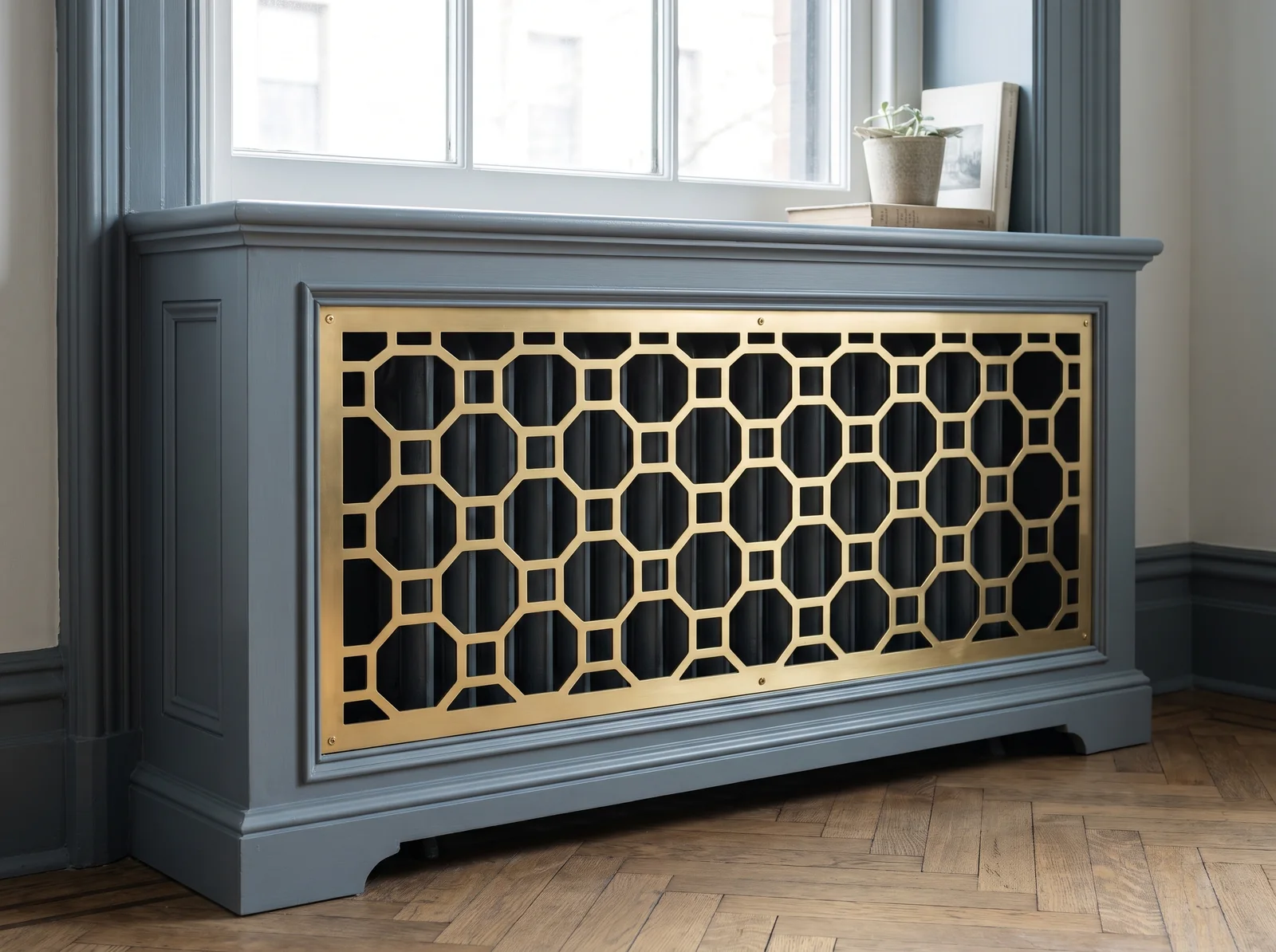
Live 16ga Radiator Panel Examples & Convective Free Area
Radiator insert panels are ordered by exact outer sheet width and height (subtract 1/8" from your wood rabbet-to-rabbet pocket). Active window open area and pricing below are calculated live from our 1:1 CAD geometry and pricing engine.
| Ordered Outer Sheet | Margin & Active Window | Active Free Area | 16ga Matte Black | 16ga Satin Brass | 1:1 CAD |
|---|---|---|---|---|---|
| 20" × 18" Compact bath or study cast-iron radiator bay (fits 20-1/8" × 18-1/8" rabbet) | 1 1/4" solid margin (17 1/2" × 15 1/2" active window) Regency Octagon & Cane | 181.3 sq in 66.9% open free area | $545 | $845 | Open in CAD |
| 22" × 18" Standard upright parlor steam cabinet (fits 22-1/8" × 18-1/8" rabbet) | 1 1/4" solid margin (19 1/2" × 15 1/2" active window) Regency Octagon & Cane | 202.6 sq in 67.0% open free area | $545 | $845 | Open in CAD |
| 28.5" × 20" Mid-span dining room enclosure (fits 28-5/8" × 20-1/8" rabbet) | 1 1/4" solid margin (26" × 17 1/2" active window) Regency Octagon & Cane | 302.8 sq in 66.6% open free area | $725 | $1,750 | Open in CAD |
| 34" × 22" Low window-seat hydronic or steam radiator front (fits 34-1/8" × 22-1/8" rabbet) | 1 1/2" solid margin (31" × 19" active window) Regency Octagon & Cane | 389.4 sq in 66.1% open free area | $985 | $2,295 | Open in CAD |
Open Free-Area Percentage: Hardware-Store Sheet vs. Laser-Cut 16ga Plate
Open area is measured across the active sightline window inside the wood cabinet stiles and rails.
| Grille Material | Typical Open Area | Sheet Thickness & Rigidity | Thermal & Millwork Behavior |
|---|---|---|---|
| Hardware-Store Cloverleaf / Union Jack Aluminum | 30%–34% open | 0.020"–0.025" thin stamped aluminum | High airflow restriction traps 140°F+ heat under wood lid; tin-snipped partial cells rattle when steam vents cycle. |
| Stock Round-Hole Perforated Mild Steel | 36%–42% open | 22ga–24ga (0.024"–0.030") sheet | Oil-cans across spans above 20"; sheared edges cut cells randomly mid-hole along wood stiles. |
| Architectural Woven Crimped Wire Mesh | 55%–65% open | Crimped wire cloth (flexible roll) | Strong convective output, but cut wire ends require a secondary interior wood bead so cloth cannot snag. |
| Brandt 16ga Craftsman Square Lattice | 54%–62% open | 0.063" (16ga) solid brass, 304 SS, or steel | Self-supporting flat sheet up to 44" × 30"; symmetric whole-cell grid framed by a clean solid rabbet border. |
| Brandt 16ga Regency Octagon & Cane | 62%–67% open | 0.063" (16ga) solid brass, 304 SS, or steel | Period parlor octagon-and-cane geometry recalculated per panel so every cell lands whole inside the wood sightline. |
Why Undersized Grille Openings Trap Steam & Hydronic Heat
Exposed cast-iron radiators deliver roughly 25% to 30% of their heat by direct radiation and 70% to 75% by natural buoyancy convection. Enclosing a radiator inside wood cabinetry blocks direct radiant transfer from the iron sections, requiring convective airflow to carry nearly the full heating load into the room.
When a DIY cover uses stamped cloverleaf aluminum sheet at 30% to 34% open area, upward draft stalls inside the box. Air temperatures beneath the top lid climb past 145°F, drying out glue joints in solid wood tops and prematurely closing cabinet-mounted thermostatic radiator valves (TRVs) while the center of the room lags behind the thermostat. Pairing a 2-1/2" to 4" open toe-space at the floor, an insulated reflective top lid liner, and a 52% to 65% open front grille restores unobstructed chimney flow.
Cabinet Rabbet Depth, Expansion Clearance & Whole-Cell Borders
Cabinetmakers typically rout a 3/8" to 1/2" wide × 3/16" deep rabbet along the inside rear face of the front wood stiles and rails. Measure the full rabbet-to-rabbet pocket width and height, then subtract 1/8 inch overall (1/16 inch per side) to establish your ordered outer sheet dimensions. Across a 34-inch one-pipe steam enclosure cycling from 65°F to 215°F, solid C260 brass expands approximately 0.010 inch while painted poplar or white oak framing moves seasonally with indoor winter humidity; 1/16-inch perimeter clearance prevents binding or buckling.
Select a solid perimeter margin (3/4", 1", 1-1/4", 1-1/2", or 2") slightly wider than your rabbet lip so a crisp band of solid metal frames the active grille window inside the wood opening. Unlike sheared stock sheet that slices octagons in half at the stile edge, our CAD solver adjusts cell pitch so every octagon, cane square, and lattice aperture lands complete and centered. Retain the panel from behind with brass turn-buttons, wood pin stops, or small dabs of flexible neutral-cure silicone so service access to steam vents and shutoff valves remains fast.
- Single-Panel Envelope (Up to 44" × 30")
- Panels larger than 23" in width or height are fabricated in 16ga (0.063") solid sheet up to 44" × 30" so they stay flat without overloading removable cabinet doors; smaller doors 23" × 23" and under can also be ordered in 1/8" (0.125") plate.
- Long Window-Seat Enclosures (Over 44")
- Divide wide radiator benches with a center vertical wood stile into two matched bays (for example, two 28.5" × 20" panels) so both bays share identical cell counts and symmetry.
Frequently Asked Specification Questions
Should I order the daylight wood opening size or the rear rabbet pocket size?
Order by outer metal sheet dimensions: measure the full rear rabbet-to-rabbet pocket width and height and subtract 1/8 inch (1/16" clearance per side). Then set your Solid Perimeter Margin in the customizer (for example, 1" or 1-1/4") to cover the rabbet lip and leave a clean solid metal reveal inside the wood sightline.
Will 16-gauge (0.063") solid brass rattle when one-pipe steam vents hiss or cycle?
No. At 0.063-inch thickness, solid C260 brass and 304 stainless steel weigh roughly three times as much as hardware-store perforated aluminum and stay flat across spans up to 44 inches. Bedding the rear rabbet corners on four small silicone bumper dots or felt pads damps any pipe vibration from the radiator.
Can a radiator grille panel also be used in a top lid where children step on a window seat?
For horizontal window-seat bench tops exposed to sitting or foot weight, keep each individual bay opening within 24" × 16" and order a Vent Grille specification in 1/8-inch (0.125") walk-on solid plate rather than 16-gauge cabinet sheet.